Showing posts with label Astrophotos—Nebulae. Show all posts

Monday, 18 November 2013

Staying power: a story of first telescopes, by Jonathan Powles.

Flame Nebula NGC 2024 and Horsehead Nebula IC 434

First posted on Jonathan's blog, and reposted here with permission.

Peter's photo of M41 brought back memories of when I first started out with Astronomy.

It was 1986, I was 19, and we all had Halley fever ... I had my first job, and my first scope soon followed: a Vixen 5" f/5 Newtonian on a very simple GEM mount. I used to run into M41 while looking at Sirius—the unexpected ones are always better I even tried some astrophotography with my dad's old SLR (no 'D')—somewhere I have some pink smudges that were my proud attempts at M42 and Eta Carina.

Sunday, 17 November 2013

A giant spider you will love: Tarantula Nebula by Steve Crouch

NGC 2070 Tarantula Nebula
Sometimes colour astrophotos tend to hide some of the detail of a deep sky object. This photo by Steve Crouch uses a Hydrogen Alpha filter to lift out detail you can't see in the standard red–green–blue light bands.

Steve explains how amazing NGC 2070 really is:
Here’s the first light image for my latest CCD camera a STXL6303 to replace my old STL6303 which has been sold.  Nothing startling – just the Tarantula.  The next upgrade to the Theodore observatory will be Martin Pugh’s old mount which should be up and running in about 2-3 weeks.
This huge emission nebula complex in the Large Magellanic Cloud would more than cover the whole constellation of Orion if placed at the position of the Orion Nebula.  It is visible with the naked eye as a hazy spot.
Catalogue and alternative designations NGC 2070, Tarantula Nebula, 30 Doradus
Type : Emission Nebula
Position: 05 38.7, -69 06
Constellation: Dorado
Camera and Telescope: STXL6303 and 36.8 cm Ritchey Chretien
Focal Ratio: F9
Exposure Details: 195 minutes unbinned exposure with Astrodon 3nm Hydrogen Alpha filter unbinned

Wednesday, 6 November 2013

A bird in flight. An incredibly detailed photo of M42 by Jonathan Powles

Just visible to the naked eye in the constellation of Orion as the central of the three 'stars' of Orion's Sword, and quite visible in ordinary binoculars, the Orion Nebula M42 is a favourite of most astronomers.

Favourite or not, it can be a challenge to do justice to in a photograph. The colour doesn't show when viewed by eye through a telescope—the nebula shows as a grey form, with a distinct 'hole' in the middle of the nebula, with four small bright stars in the middle of that hole. (There are actually eight stars there, of which several are now known to be binaries. But with amateur telescopes we see them as four.)

When showing this to new viewers I explain that this shows how the dust of the nebula collapsed in to form the new stars. The nebula therefore is a 'star factory'.

Friday, 1 November 2013

Check this trio of space gorgeousness from Chris Marklew

Carina Nebula NGC3372
Carina Nebula NGC 3372


Chris Marklew sent through this collection of three beauties, with this unassuming introduction:
I have reprocessed some images from earlier in the year after learning a bit more about processing, the comet was by far the hardest to do without star trails
Time well spent it would seem!

Friday, 25 October 2013

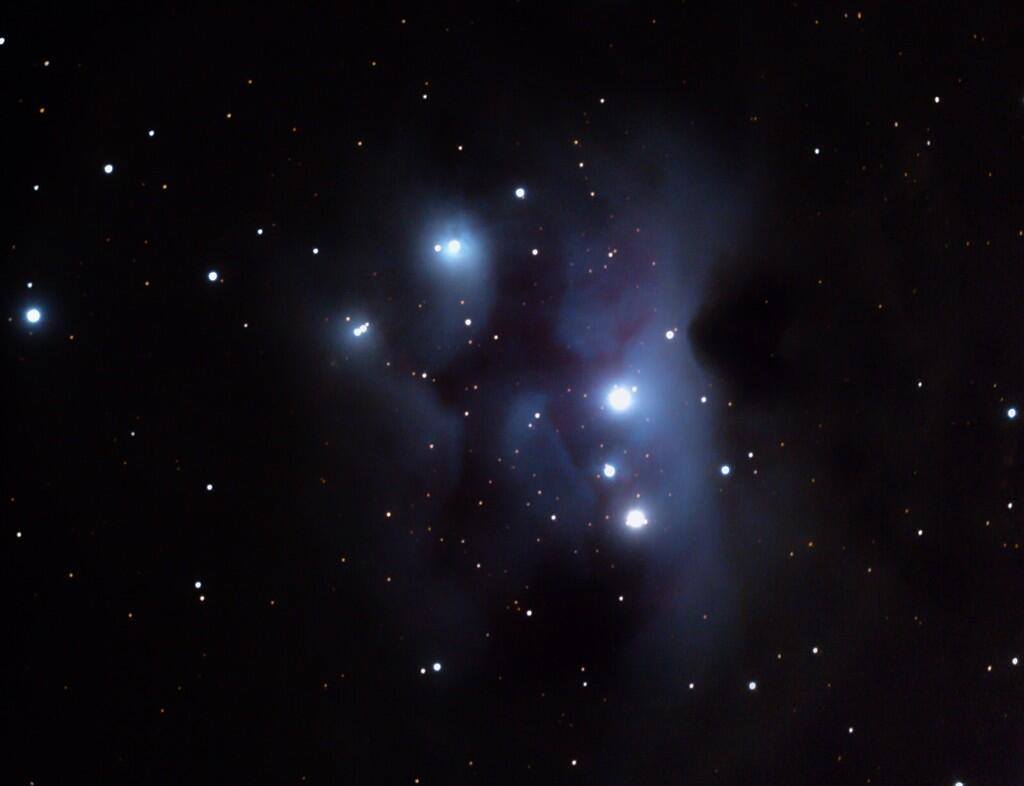
The Running Man Nebula, by Jonathan Powles

The constellation of Orion is a rich area for astronomers. Here's the Running Man Nebula NGC 1977, which is right next to the famous Orion Nebula M42. The running man in question is actually comprised of the darker areas rather than the bright patches. Yes, you have to use some imagination. It's often that way!

Here's a photo from Wikipedia showing where this nebula is, just to the left of Orion (look at the pattern of the bright stars):

Tuesday, 1 October 2013

NGC 456 Deep Inside the Small Magellanic Cloud, by Steve Crouch

NGC 456

Steve Crouch explains this intriguing shot:
This is a chain of nebulous star clusters in the Small Magellanic Cloud some 20' long. There is considerable OIII emission present. This is a not-often imaged area of the SMC. I don’t really know why there aren’t more images of it.
Catalogue and alternative designations NGC 456 region
Type SMC nebulous star clusters
Position 01 14.4, -73 17
Constellation Tucana (SMC)
Camera and Telescope STXL11002 and 36.8 cm Ritchey Chretien
Focal Ratio F9
Exposure Details LRGB 180:50:50:50 Luminance 1x1, Colours 2x2.  Baader filters

Lagoon Nebula by Mark Nickols


Mark Nickols took this great shot of the Lagoon Nebula from his suburban Canberra back yard, light pollution and all. He uses a 200mm Meade LX200, which is an Alt-Azimuth mount, with a wedge to allow him to align with the South Celestial Pole.
Last image from me for a while as scope goes to scope hospital for investigative surgery. Hoping for some improvement in visual acuity as a result.
This one: 3 x 3 min exposures + 2 x 4 min exposures stacked (that might give a clue to why the scope is going in for repair) LX200 8". Camera: SBIG STF-8300C


Monday, 30 September 2013

Stunning photo of the Trifid Nebula, by Chris Marklew

The Trifid Nebula (NGC6514)
Chris explains:
It has been awhile since capturing data for a new image (~6months), but here it is, The Trifid Nebula (NGC6514).
Image details
Telescope: FSQ106EDXIII
Camera: SBIG STT-8300M
Composition: LRGB (152:45:40:40) bin L 1x1, RGB 2x2
Captured: 25, 27, and 29 September 2013 - Canberra

Tuesday, 10 September 2013

Tarantula Nebula, by Mark Nickols


Good astrophotography is completely reliant on reliable tracking by the telescope. You have the mount, your computer, tracking and guidance software, and all the pieces in the chain have to be working and communicating properly with each other. There's nothing 'plug-and-play' about this game and when things don't go right, it can be incredibly frustrating.

Mark Nickols, despite experiencing such problems, still managed to pull off this nice shot of the Tarantula Nebula, part of the Large Magellanic Cloud, a small galaxy close to ours at about 163,000 light years:
I'm currently battling some guiding issues. In the early hours two nights ago, after some frustrating hours on another target, as an additional experiment I turned the scope to the tarantula nebula. The guiding software refuses to work at all for this target I guess because it is too near the pole and the software complains that the stars are not moving enough too do a calibration. Anyway I got off just a small number of shots before things got very hazy and I had to give up. So here anyway is just 8 x 2 minute stacked exposures of the tarantula - unguided. Could have been centred better but could be worse.

Wednesday, 21 August 2013

The Dumbell Nebula, Messier 27, by Jovan Kulic


The Dumbell Nebula is in the constellation Vulpecula, near Cygnus. Lovely work Jovan for a sight very low down through a lot of atmosphere.
Here is my latest image, The Dumbbell Nebula,  Messier 27. The data was collected over 2 nights a few weeks ago with the nebula just poking its head over my neighbour’s roof.

Ha 6 x 20 minutes.
RGB 5 x 5 minutes each.
The image is approx. 30 x 40 arc minutes.

Thursday, 20 June 2013

Bug Nebula NGC 6302 in Hydrogen Alpha


By Steve Crouch:

This was a quick Hydrogen Alpha of the Bug nebula (NGC 6302) that I took last night in windy conditions.  Will try to get some colour soon.

Wednesday, 12 June 2013

NGC 6992 and NGC 6960—the Veil Nebula

NGC 6992—part of the Veil Nebula complex


By Steve Crouch:

I got some data for NGC 6992, the other side of the Veil nebula, over the last few days. I must admit I don’t think it turned it out as well as NGC 6960 but for what they are worth here are both images.

Tuesday, 4 June 2013

NGC 6559—Does this have a nickname?


By Jonathan Powles

I was exploring Sagittarius over the last couple of nights, as you do, and I pointed the scope at what Skytools 3 tells me is a patch of nebulosity NGC 6559, and started to take some photos.

I was totally blown away by what I was seeing: bright and faint emission nebulosity; bright blue and also some yellow reflection nebulosity, wonderfully intricate dark dust lanes ... this little patch of sky has it all.