Showing posts with label Astrophotos—Globular Clusters. Show all posts

Sunday, 29 September 2013

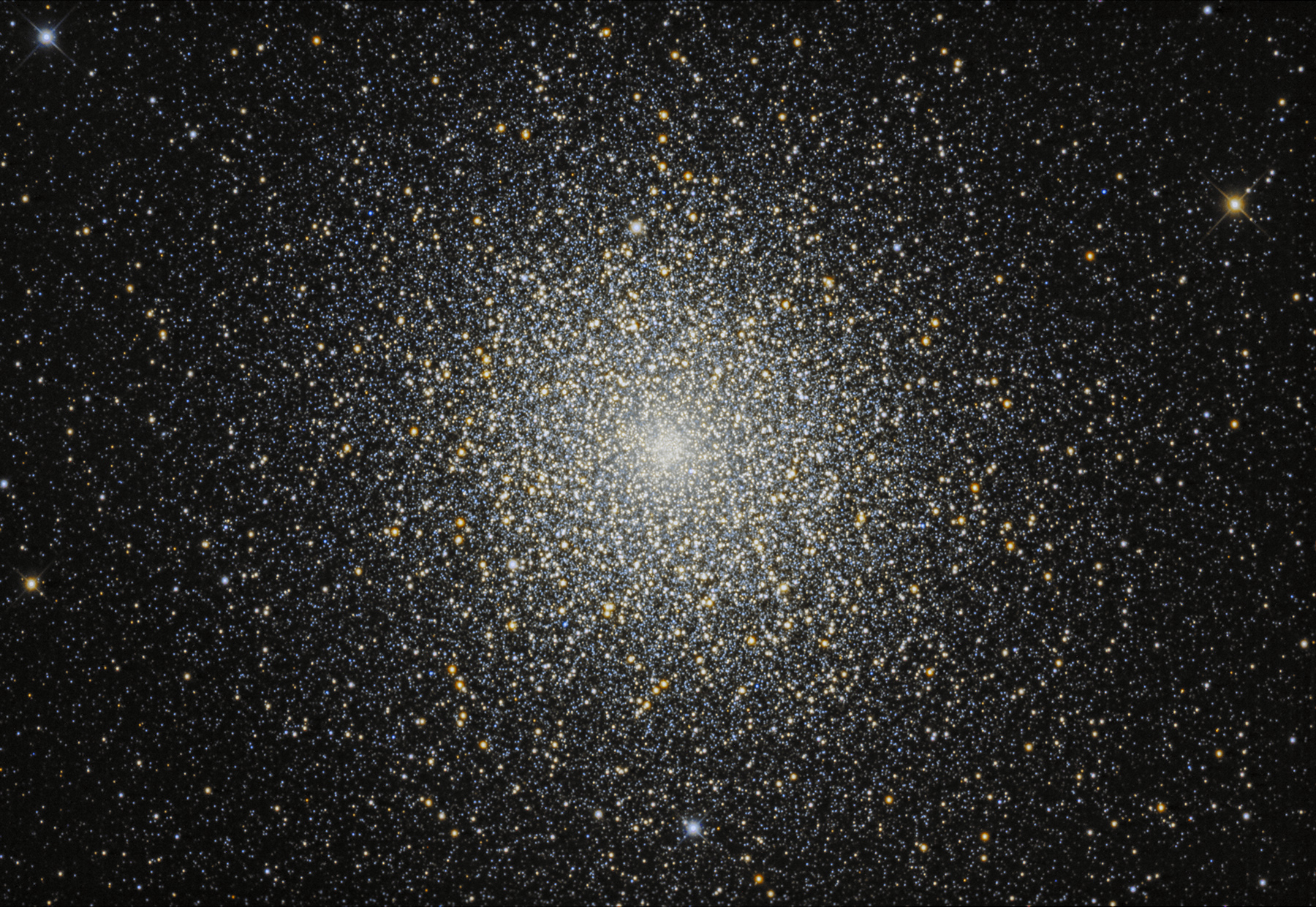
One million solar masses crammed into one spot. Globular cluster 47 Tucanae, by Steve Crouch


While delving around the SMC I couldn’t resist doing a shot of 47 Tucanae which I haven’t imaged for several years.  This is 45 minutes exposure for each of L,R,G and B with the RGB added into L for synthetic luminance. 
Catalogue and alternative designations NGC 104, 47 Tucanae
Type Globular Cluster
Position 00 24.1, -72 05
Constellation Tucana
Camera and Telescope STXL11002 and 36.8 cm Ritchey Chretien
Focal Ratio F9
Exposure Details LRGB 90:45:45:45 All 1x1.  Synthetic luminance used.
Description 47 Tucanae is the second brightest globular cluster in the sky but has a much stronger central condensation than Omega Centauri.  It is adjacent to the Small Magellanic Cloud and a very easy naked eye object.


Thursday, 26 September 2013

The globular cluster 47 Tucanae, by Mark Nickols


In the Southern Hemisphere, we have some of the best globular clusters, including the biggest of all Omega Centauri with some five million solar masses, and this beauty: 47 Tucanae with about one million solar masses. Here's a good shot of "47 Tuc" by Mark Nickols:
I'm still struggling with guiding issues, but just to prove my issue is not optics, I again pointed the scope southward where things don't move around so much and snapped 47 Tucanae last night, just to prove I can manage to take round stars (as opposed to eggs, tadpoles, dumbbells, etc). I personally prefer Omega Centauri, but it's pretty impressive nonetheless (the globular cluster, not necessarily the image).
10 x 3 minute exposures. Scope: LX200 8", f/6.7 focal reducer.Camera: SBIG STF8300C